CMP stacking
Jump to navigation
Jump to search
 | |
| Series | Investigations in Geophysics |
|---|---|
| Author | Öz Yilmaz |
| DOI | http://dx.doi.org/10.1190/1.9781560801580 |
| ISBN | ISBN 978-1-56080-094-1 |
| Store | SEG Online Store |
A new velocity field as shown in Figure 1.5-18 is derived from the velocity functions picked from the velocity spectra after DMO correction. As for the velocity field in Figure 1.5-12, red in the shallow portion and blue in the deep portion of the section correspond to low and high velocities, respectively. This new velocity field is used to apply NMO correction to the CMP gathers (Figure 1.5-19). Finally, a CMP stack is obtained (Figure 1.5-20) by summing over the offset axis. The stack is the frontal face of the data volume shown in Figure 1.5-1.
-
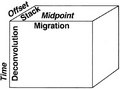 Figure 1.5-1 Seismic data volume represented in processing coordinates — midpoint-offset-time. Deconvolution acts on the data along the time axis and increases temporal resolution. Stacking compresses the data volume in the offset direction and yields the plane of stacked section (the frontal face of the prism). Migration then moves dipping events to their true subsurface positions and collapses diffractions, and thus increases lateral resolution.
 -
 Figure 1.5-12 Velocity field over the length of the seismic line under consideration. This isovelocity contour map was derived using the velocity picks from the spectra in Figure 1.5-11.
 -
 Figure 1.5-18 Stacking velocity field over the length of the seismic line under consideration. This isovelocity contour map was derived using the velocity picks from the spectra in Figure 1.5-17.
 -
 Figure 1.5-19 The CMP gathers as in Figure 1.5-16 after NMO correction and muting using the stacking velocity field in Figure 1.5-18.
 -
 Figure 1.5-20 The CMP stack associated with the gathers in Figure 1.5-19.


See also
- Preprocessing
- Deconvolution
- CMP sorting
- Velocity analysis
- Normal-moveout correction
- Multiple attenuation
- Dip-moveout correction
- Poststack processing
- Migration
- Residual statics corrections
- Quality control in processing
- Parsimony in processing
External links
| find literature about CMP stacking |

|

|

|

|

|

|

|