Volcano
 |
This article originated from the Critical Issues Program authored by the American Geosciences Institute. To learn more about AGI or the Critical Issues Program, visit http://www.americangeosciences.org/critical-issues. |
An explosive volcano can devastate its local area with mudflows, lava flows, and avalanches of hot rock and gas. Mudflows from ice-clad volcanoes like Mt. Rainier can travel tens of miles from the volcano. Some volcanic hazards, such as ash fall, can even impact areas hundreds of miles away. While it is not possible to forecast the exact time and place of an eruption, volcano monitoring is important in order to detect changes in a volcano's activity and provide warning of potential eruptions.
Why do volcanoes matter?
As populations expand, more people, property, and airline routes are exposed to volcanic hazards. Volcanoes in the United States principally affect the West Coast states, Hawaii, and Alaska, but ash from eruptions can travel hundreds of miles, grounding flights and hindering ground transportation. The last major eruption in the lower United States occurred at Mount St. Helens in Washington in 1980, causing nearly $1 billion in losses to forestry, agriculture, buildings, and roads.[1][2]
-
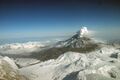 Ash from Mt. Redoubt, a remote volcano in Alaska, can threaten many aviation routes. U.S. Geological Survey/Photo by Game McGinsey
 -
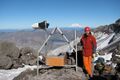 A U.S. Geological Survey seismologist installs a monitoring station on Mt. St. Helens. Credit: U.S. Geological Survey
 -
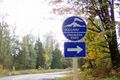 Evacuation sign at Mt. Rainier. Credit: U.S. Geological Survey


How does geoscience help inform decisions about volcanic hazards?
Geoscientists monitor volcanoes and study how they work in order to forecast eruptions. They also produce maps to predict the extent and impact of volcanic hazards.
Introductory resources
- Types of Volcano Hazards, U.S. Geological Survey
- Basic information on the main types of volcano hazards: gases, lahars, landslides, lava flows, pyroclastic flows, and tephra. Each hazard's page also overviews triggers, effects, case studies, and warning systems.
Frequent questions
- How many active volcanoes are there in the United States?
- Can volcanoes be dangerous even when they don't erupt?
- What kinds of hazards are associated with volcanic eruptions?
- Why is monitoring volcanoes important to aviation?
- Why is it important to monitor volcanoes?
References
- ↑ Washington State Department of Commerce and Economic Development Research Division, cited by Oregon State University, "Cost of Volcanic Eruptions" http://volcano.oregonstate.edu/cost-volcanic-eruptions, accessed May 15 2014
- ↑ The Economic Effects of the Eruptions of Mt. St. Helens: Report to the Committee on Ways and Means of the U.S. House of Representatives on Investigation No. 332-110 Under Section 332 of the Tariff Act of 1930. (1980), United States International Trade Commission Publication 1906 http://volcanoes.usgs.gov/vsc/file_mngr/file-78/pub1096.pdf
See also
- Volcano Basics, American Geosciences Institute
- Drought
- Earthquake
- Flood
- Landslide
- Sinkhole
- Tsunami
- Waste management
- Weather hazards
External links
| find literature about Volcano |

|

|

|

|

|

|

|