Bandwidth and vertical resolution
 | |
| Series | Investigations in Geophysics |
|---|---|
| Author | Öz Yilmaz |
| DOI | http://dx.doi.org/10.1190/1.9781560801580 |
| ISBN | ISBN 978-1-56080-094-1 |
| Store | SEG Online Store |
Frequency filtering is intimately tied to vertical (temporal) resolution of seismic data. Consider the filter operators in Figure 1.1-28. Both have the same effective bandwidth — the difference between the high-cut and low-cut frequencies. Therefore, the envelopes of the two operators are identical. The greater ringyness of the second operator (Figure 1.1-28b) results from its lower bandwidth ratio — the ratio of the high-cut to the low-cut frequency.
There is a common misunderstanding that only high frequencies are needed to increase temporal resolution. This is not true. The top frame in Figure 1.1-29 shows a single reflector and three sets of closely situated reflectors with 48-, 24-, and 12-ms time separations. A series of narrow band-pass filters is applied to these data as shown in the lower frames. The reflectors with the 48-ms separation are resolved reasonably well by using the 10-to-20-Hz bandwidth. However, the more closely situated reflectors cannot be resolved with this filter. For the 20-to-30-Hz bandwidth, again, the 48-ms reflectors are reasonably separated. Nevertheless, none of the narrow band-pass filters provides the resolution needed to distinguish the reflectors situated with smaller separations. Just having low or high frequencies does not improve temporal resolution. Both low and high frequencies are needed to increase temporal resolution. This is demonstrated further in Figure 1.1-30. Note that closely situated reflectors can be resolved only with increasingly broader bandwidth. The 10-to-30-Hz bandwidth is sufficient to resolve the reflectors with 48-ms separation. The 10-to-50-Hz bandwidth is sufficient to resolve the reflectors with 24-ms separation. Finally, the 10- to-100-Hz bandwidth is needed to resolve the reflectors that are separated by 12 ms. There is a close relationship between the amount of separation and the desired bandwidth (seismic resolution).
-
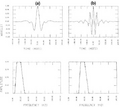 Figure 1.1-28 Two wavelets (top row) with the same bandwidth (bottom row). The passband of wavelet (a) is centered at 15 Hz, while that of wavelet (b) is centered at 35 Hz. Both wavelets have ripples, although one is low and the other is high frequency in character. Just having low or high frequencies does not suffice; both are needed to increase temporal resolution.
 -
 Figure 1.1-29 The top section is a reflectivity model that consists of, from left to right, three reflectors with 48-ms separation, three reflectors with 24-ms separation, three reflectors with 12-ms separation, and a single reflector — all centered at 1 s. Band-limited responses (the same bandwidth, 10 Hz, centered at different frequencies) do not provide good resolution.
 -
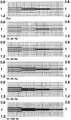 Figure 1.1-30 The top section is the same reflectivity model as in Figure 1.1-29. Reflectors with large separation (48 ms) are resolvable with a bandwidth as low as 10 to 30 Hz. However, reflectors with smaller separation (24 and 12 ms) require increasingly larger bandwidths for resolution.


See also
- Analog versus digital signal
- Frequency aliasing
- Phase considerations
- Time-domain operations
- Convolution
- Crosscorrelation and autocorrelation
- Vibroseis correlation
- Frequency filtering
- Practical aspects of frequency filtering
- Time-variant filtering
External links
| find literature about Bandwidth and vertical resolution |

|

|

|

|

|

|

|